📖 5 minutes read | ⚙️ Automation & Instrumentation
Ever wondered how your car's cruise control knows when to speed up or slow down? Or how industrial plants maintain perfect temperature without someone constantly adjusting knobs? Welcome to the fascinating world of control loops – the unsung heroes of automation that keep our modern world running smoothly!
Control loops are the backbone of automation and instrumentation systems. Think of them as the “brain” that continuously monitors a process and makes adjustments to keep everything running exactly as it should. Whether you’re brewing coffee, refining oil, or launching rockets, control loops are working behind the scenes.
Let’s dive into the different types of control loops you’ll encounter in the automation world. Don’t worry – I’ll keep it simple and throw in some relatable examples (and maybe a dad joke or two).
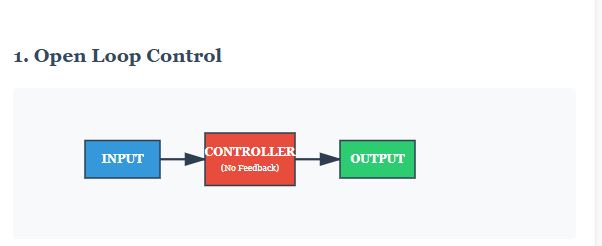
Open loop control is like setting a timer on your washing machine and walking away. You give it instructions, it does its thing, and there’s no checking back to see if everything’s going according to plan. Simple? Yes. Foolproof? Not exactly.
🎭 Real-life moment: It's like making toast without watching it. You set the timer for 2 minutes and hope for the best. Sometimes you get perfect toast, sometimes you get charcoal. The toaster doesn't care – it has no feedback!
How it works: The controller receives an input signal, processes it according to predetermined logic, and sends an output command. That’s it. No monitoring, no adjustments, no second-guessing.
Common examples: Traffic light timers, automatic door openers, hand dryers, and yes – your basic toaster.
Pros: Simple, inexpensive, easy to design and maintain.
Cons: No error correction, sensitive to disturbances, inconsistent results.
Read More About Open Loop Control →
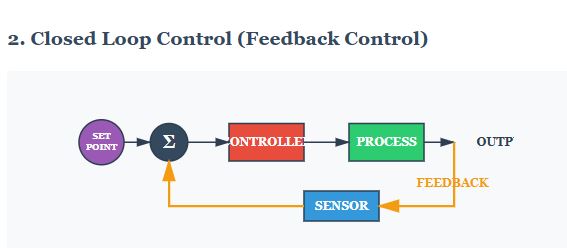
Now we’re talking! Closed-loop control is like having a smart chef in your kitchen. They don’t just set the oven and walk away – they constantly taste, adjust seasoning, and monitor temperature. This is where automation gets intelligent.
I’ve shared a video tutorial below if you’d like to learn through that format. Feel free to check it out.
🌡️ Relatable moment: Your home thermostat is the perfect example. You set it to 72°F, it measures the actual temperature, and if it's 68°F, it kicks on the heater. When it hits 72°F? The heater takes a break. It's like having a temperature-obsessed roommate who's actually helpful!
How it works: The system continuously measures the output, compares it with the desired setpoint, calculates the error, and adjusts the input accordingly. It’s a never-ending cycle of measure-compare-adjust.
Common examples: Home HVAC systems, cruise control in cars, industrial temperature control, water level control in tanks.
Pros: Automatic error correction, accurate, handles disturbances well, maintains consistency.
Cons: More complex and expensive, can become unstable if poorly tuned, requires sensors.
Read More About Close Loop Control →
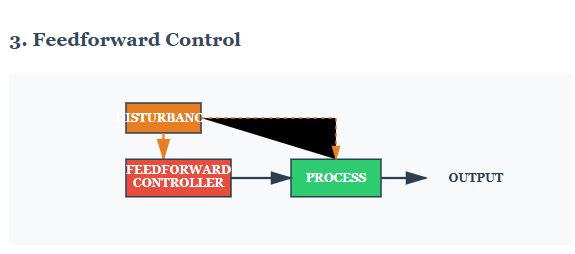
Feedforward control is the fortune teller of automation. Instead of waiting for problems to happen and then fixing them, it predicts disturbances and takes action BEFORE they affect the output. It’s proactive, not reactive.
☂️ Think of it this way: You’re driving and see a hill coming up. Instead of waiting for your car to slow down and then hitting the gas (feedback), you press the accelerator BEFORE you start climbing (feedforward). You’re basically outsmarting physics!
How it works: The system measures disturbances that could affect the process and immediately adjusts the control action to compensate. It’s all about anticipation.
Common examples: Chemical dosing systems where raw material composition changes, heating systems that adjust based on outdoor temperature, industrial processes with measurable load changes.
Pros: Fast response, prevents errors before they occur, no oscillation issues.
Cons: Requires knowledge of disturbances, can’t correct for unmeasured disturbances, complex modeling needed.
Read More About Feedforward control→
I’ve shared a video tutorial below if you’d like to learn through that format. Feel free to check it out.
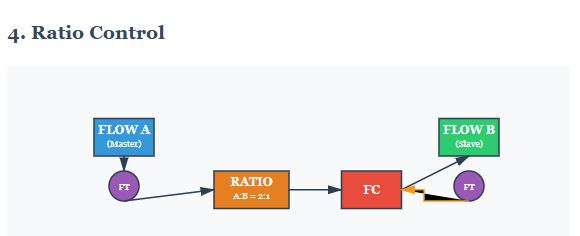
Ratio control is like making a perfect cocktail every single time. Whether you’re making one drink or a hundred, the ratio of ingredients stays the same. In industrial processes, this is absolutely critical for quality and safety.
🍹 Bartender logic: Imagine a bartender who always pours drinks in perfect 2:1 ratio of juice to vodka. Even if someone orders a small drink or a fishbowl-sized one, that ratio never changes. That's ratio control – keeping relationships constant even when quantities vary!
How it works: One flow (the “master”) is measured, and a second flow (the “slave”) is automatically adjusted to maintain a specific ratio. When the master changes, the slave follows proportionally.
Common examples: Fuel-to-air ratio in combustion, mixing chemicals in precise proportions, blending different materials, concrete mixing plants.
Pros: Maintains perfect proportions, ensures product quality, simple concept.
Cons: Depends on master flow accuracy, doesn’t account for composition changes, requires good flow measurement.
Read More About Feedforward control→
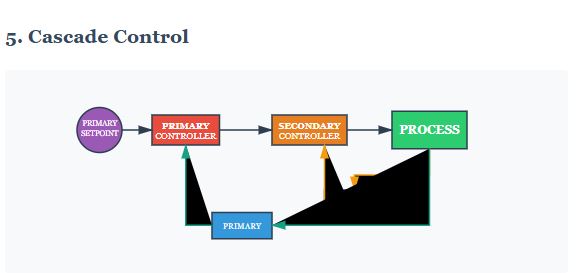
Cascade control is like having a manager and a supervisor working together. The manager sets the big-picture goal, and the supervisor handles the day-to-day details. It’s control on two levels, and it’s brilliant for complex processes.
🎯 Parent-teenager analogy: Parent says "Be home by 10 PM" (primary controller). Teenager realizes they need to leave the party by 9:30 PM to make it (secondary controller managing the intermediate step). Two control loops, one mission!
How it works: Two controllers work in series. The primary (master) controller’s output becomes the setpoint for the secondary (slave) controller. The secondary loop responds quickly to disturbances before they affect the primary variable.
Common examples: Temperature control using flow control, pressure control in distillation columns, reactor temperature control, heat exchanger systems.
Pros: Faster disturbance rejection, improved stability, better control of slow processes.
Cons: Complex tuning process, requires two measurements, more expensive implementation.
Read More About Cascade Control →
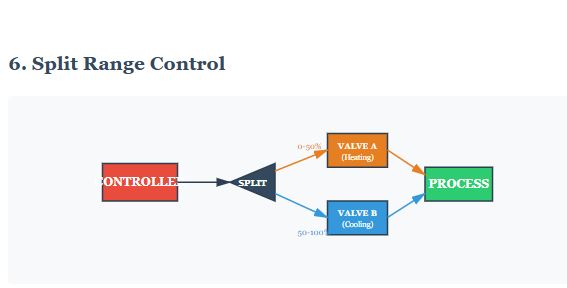
Split range control is the multitasker of the automation world. One controller, but it operates multiple final control elements in different ranges. It’s like using one remote to control both your lights and fan – one button, different actions depending on the setting.
🌡️ The temperature dilemma: You're in a room that's sometimes too hot, sometimes too cold. You have one thermostat controlling both heater and AC. Below 70°F? Heater works. Above 70°F? AC kicks in. One controller, two opposite actions. That's split range in action!
How it works: A single controller output is split into ranges (like 0-50% and 50-100%), with each range controlling different equipment. As the output crosses thresholds, different valves or actuators take over.
Common examples: Reactor temperature control (heating and cooling), pressure control (venting and pressurizing), pH control (acid and base addition).
Pros: One controller for opposing actions, cost-effective, prevents simultaneous heating and cooling.
Cons: Potential dead band issues, complex valve sizing, tricky calibration at range boundaries.
Read More About Split Range Control →
Wrapping It Up
Control loops are everywhere – from the coffee maker on your counter to the massive refinery down the road. Understanding these different types helps you choose the right solution for your automation challenges.
Remember:
- Open loop = Set it and forget it (hope for the best!)
- Closed loop = Constantly adjusting (the perfectionist)
- Feedforward = Predicting the future (the fortune teller)
- Ratio = Perfect proportions (the bartender)
- Cascade = Tag team control (manager + supervisor)
- Split range = One controller, multiple personalities
Each type has its place, and often the best solution combines multiple strategies. The key is understanding your process, identifying potential disturbances, and choosing the control strategy that gives you the best performance for your investment.
Now go forth and control your processes like a boss! And remember – in automation, feedback is always welcome. 😉