Cascade Control: The Tag Team Champions
What Is Cascade Control?
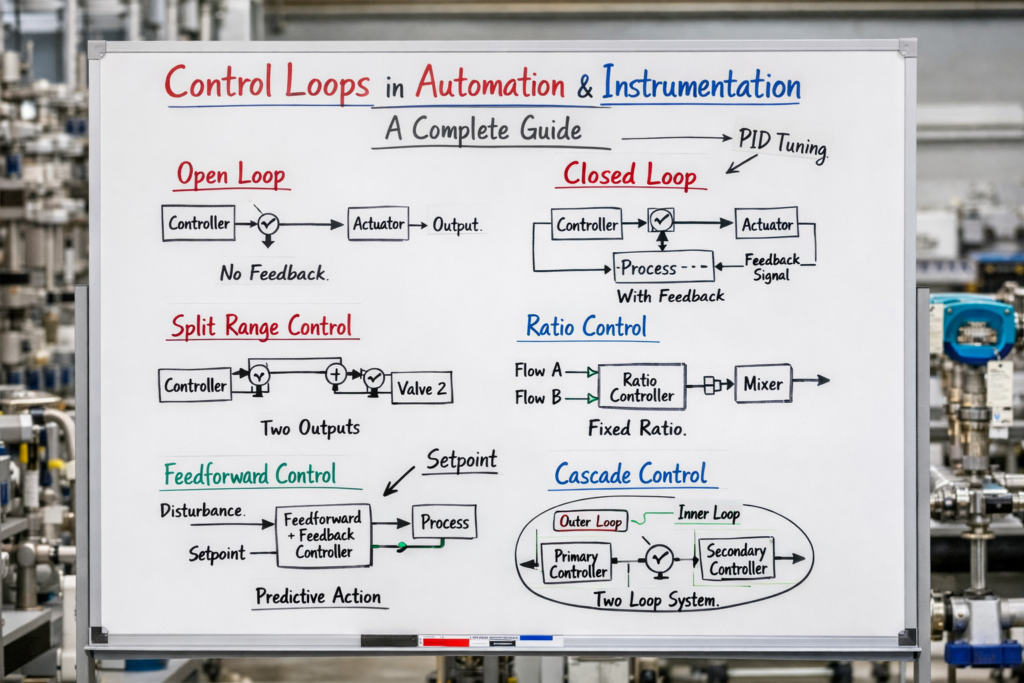
Cascade control uses two controllers in series: a primary (master) controller that sets the overall goal, and a secondary (slave) controller that handles the immediate action. The primary controller’s output becomes the secondary controller’s setpoint.
The hierarchy:
- Primary: Controls the ultimate variable you care about (temperature, composition, level)
- Secondary: Controls the intermediate variable that affects the primary (flow, pressure, valve position)
Cascade Control Architecture
How It Actually Works
The Control Sequence:
- Primary Measurement: Sensor reads outlet temperature = 85°C
- Primary Error Calculation: Setpoint 90°C – Actual 85°C = 5°C error
- Primary Decision: “Need more heat. Request 120 kg/hr steam flow”
- Secondary Receives Setpoint: Target = 120 kg/hr steam
- Secondary Measurement: Current steam flow = 100 kg/hr
- Secondary Action: Opens valve to increase flow to 120 kg/hr
- Disturbance Hits: Steam pressure drops suddenly
- Secondary Responds FAST: Opens valve more to maintain 120 kg/hr
- Primary Barely Notices: Temperature stays steady because secondary handled it
🏢 The Corporate Analogy
Primary Controller = CEO
- Sets high-level goals: “Increase quarterly revenue by 10%”
- Checks progress monthly/quarterly (slow loop)
- Doesn’t handle daily fires
Secondary Controller = Department Manager
- Receives goal from CEO: “10% revenue increase”
- Makes daily decisions to achieve it
- Handles problems immediately (fast loop)
- Shields CEO from daily chaos
Why this works: CEO doesn’t get overwhelmed with details. Manager handles rapid changes. Both work at their optimal pace. Same concept in cascade control!
Real-World Industrial Examples
🔥 Example 1: Heat Exchanger Temperature Control
Primary Goal: Maintain outlet temperature at 90°C
Primary Variable: Outlet temperature (slow to change)
Secondary Variable: Steam flow rate (fast to control)
The Problem with Single Loop:
- Temperature controller adjusts valve directly
- Steam pressure fluctuates → Flow changes → Temperature swings
- Controller constantly fighting pressure variations
- Poor control, lots of oscillation
Cascade Solution:
- Primary: Temperature controller says “I need X flow”
- Secondary: Flow controller maintains X flow regardless of pressure changes
- Result: Pressure variations never affect temperature—secondary handles them instantly
Performance improvement: Temperature variance reduced from ±3°C to ±0.5°C
⚗️ Example 2: Chemical Reactor Temperature
Primary Goal: Reactor temperature at 150°C (critical for product quality)
Primary Variable: Reactor temperature (very slow—large thermal mass)
Secondary Variable: Cooling water flow (fast response)
Why cascade is essential:
- Exothermic reaction generates heat (disturbance)
- Cooling water pressure varies with plant demand
- Single loop would oscillate wildly trying to manage both
Cascade setup:
- Primary: Temperature controller (scan every 10 seconds)
- Secondary: Flow controller (scan every 0.5 seconds)
- Flow loop catches pressure changes before they affect temperature
- Temperature loop only deals with slow thermal changes
📦 Example 3: Tank Level with Variable Pressure Supply
Primary Goal: Tank level at 75%
Primary Variable: Tank level (slow to change)
Secondary Variable: Inlet flow rate (fast to control)
The disturbance: Upstream pressure varies 3-7 bar
Single loop problem:
- Level controller adjusts valve opening
- Pressure jumps from 3 to 7 bar
- Same valve opening now gives 2× more flow!
- Level overshoots, controller closes valve
- Pressure drops, level falls
- Constant hunting and cycling
Cascade solution:
- Level controller says “I want 50 m³/hr”
- Flow controller maintains exactly 50 m³/hr by compensating for pressure
- Pressure changes handled in milliseconds by inner loop
- Level stays rock-solid
Response Comparison: Single Loop vs Cascade
Key Requirements for Cascade Control
1. Speed Difference (CRITICAL)
Rule of thumb: Secondary loop must be 3-5× faster than primary
Why: Secondary must settle before primary reacts, or they fight each other
Examples that work:
- Temperature (slow) controlling Flow (fast) ✓
- Level (slow) controlling Flow (fast) ✓
- Composition (very slow) controlling Temperature (medium) ✓
Examples that DON’T work:
- Flow (fast) controlling Temperature (slow) ✗
- Pressure (fast) controlling Level (slow) ✗
2. Clear Cause-Effect Relationship
Secondary variable must directly and significantly affect primary variable
- Steam flow → Affects temperature ✓
- Coolant flow → Affects temperature ✓
- Reflux ratio → Affects composition ✓
3. Measurable Secondary Variable
Must have reliable sensor for inner loop variable
- Flow meters (common secondary)
- Pressure transmitters
- Intermediate temperature sensors
4. Secondary Disturbances Exist
Only worth it if secondary variable faces frequent disturbances that cascade can reject faster
- Pressure fluctuations affecting flow
- Varying heat source temperatures
- Load changes on shared utilities
Tuning Cascade Control
Tuning Sequence (ALWAYS in this order):
Step 1: Put Primary in Manual
Set primary controller to manual mode. You’ll tune secondary first.
Step 2: Tune Secondary Loop
- Secondary controller in auto mode
- Give it various setpoint changes
- Tune PID parameters for fast, stable response
- Goal: Quick settling, minimal overshoot
- Typical: Aggressive tuning (high gain, fast integral)
Step 3: Verify Secondary Performance
- Secondary should track setpoint changes quickly
- Should reject disturbances rapidly
- No oscillation or hunting
Step 4: Put Primary in Auto
Now enable primary controller
Step 5: Tune Primary Loop
- Secondary stays in auto
- Tune primary for smooth control
- Goal: Minimal overshoot on primary variable
- Typical: Conservative tuning (lower gain, slower integral)
Advantages & Limitations
✅ Advantages
- Better Disturbance Rejection: Secondary catches problems before primary sees them
- Faster Response: Inner loop reacts immediately
- Less Oscillation: Each loop operates at optimal speed
- Improved Stability: Primary loop sees well-controlled input
- Tighter Control: Reduced variance on primary variable
- Handles Non-linearities: Secondary compensates for valve characteristics, pressure effects
❌ Limitations
- Complexity: Two controllers to configure and maintain
- Tuning Difficulty: Must tune in correct sequence
- Extra Sensor Cost: Need measurement for secondary variable
- Speed Requirement: Only works if secondary significantly faster
- Troubleshooting: Harder to diagnose which loop has issues
Common Applications
| Industry | Application | Primary Loop | Secondary Loop |
|---|---|---|---|
| Chemical | Reactor temperature | Temperature | Coolant flow |
| Refining | Distillation column | Composition | Reflux flow |
| Power | Boiler steam temp | Steam temperature | Spray water flow |
| HVAC | Room temperature | Room temp | Valve position/flow |
| Food | Pasteurization | Product temp | Steam flow |
| Pharmaceutical | Fermentation | Temperature/pH | Coolant/acid flow |
| Pulp & Paper | Dryer section | Paper moisture | Steam pressure |
Troubleshooting Cascade Control
| Problem | Symptom | Likely Cause | Solution |
|---|---|---|---|
| Continuous oscillation | Both loops cycling | Loops too close in speed, or primary too aggressive | Detune primary, verify secondary is faster |
| Secondary saturates | Secondary at 0% or 100% | Primary requesting impossible setpoint | Add output limits on primary |