
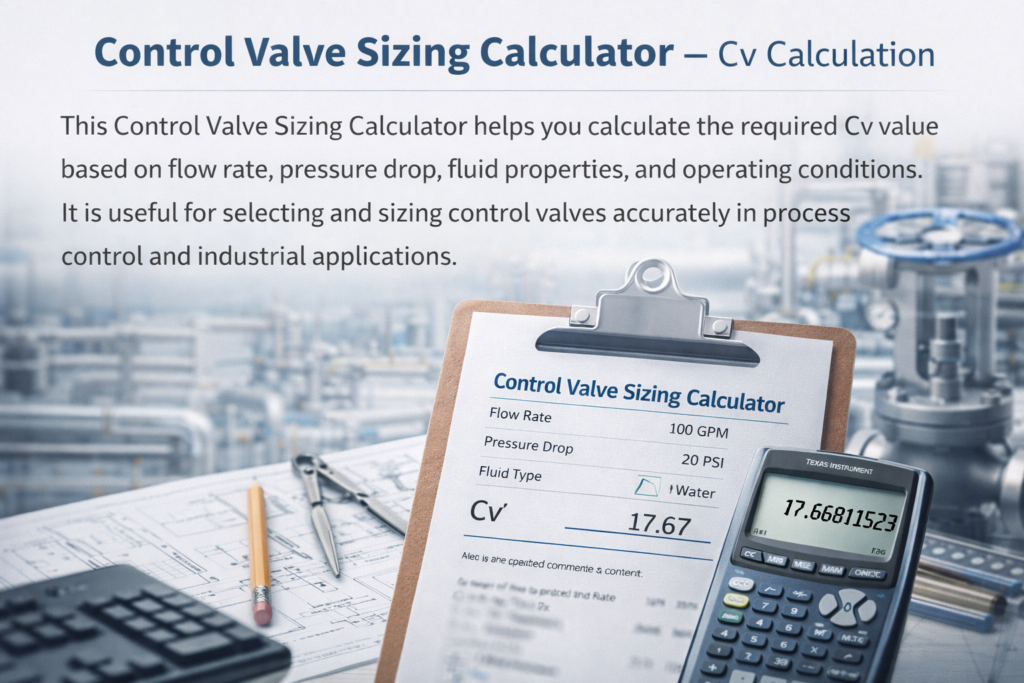
This Control Valve Sizing Calculator helps you calculate the required Cv value based on flow rate, pressure drop, fluid properties, and operating conditions.
It is useful for selecting and sizing control valves accurately in process control and industrial applications.
📘 Control Valve Sizing Calculator – User Guide
- This calculator estimates control valve Cv based on ISA-75.01.01 / IEC 60534-2-1 standards for liquid and gas applications.
- Select Unit System (Metric / Imperial) and Fluid State (Liquid or Gas).
The calculator automatically adjusts formulas and input requirements. - Enter fluid properties such as specific gravity, vapor pressure, viscosity (for liquids), or molecular weight, compressibility, and heat ratio (for gases).
- Provide Minimum, Normal, and Maximum operating conditions:
- Flow rate
- Liquid → m³/h
- Gas → kg/h
- Inlet pressure (P1 – gauge)
- Outlet pressure (P2 – gauge)
- Temperature (required for gas)
- Flow rate
- Gauge pressures are automatically converted to absolute pressure during calculation.
- Valve-specific factors (Fₗ for liquid, xₜ for gas) are used to check choked flow conditions.
- The calculator determines:
- Required Cv for each case
- Maximum Cv as recommended valve sizing Cv
- After entering the selected valve rated Cv, estimated valve openings are shown for:
- Minimum
- Normal
- Maximum flow conditions
- Warnings appear if the valve is oversized, undersized, or operating near fully open or closed positions.
- A Cv vs Valve Opening characteristic curve is generated using the selected valve characteristic to visualize controllability.
Control Valve Sizing Calculator
ISA-75.01.01 / IEC 60534-2-1
⚠️ Preliminary sizing only. Final valve selection must be confirmed with manufacturer data.
Cv vs Valve Opening Curve
Flow coefficient (Cv) as a function of valve position
Linear Characteristic
Flow increases proportionally with valve opening (Cv = Max Cv × % Opening). Best for applications with constant pressure drop across the valve. This provides a straight-line relationship between valve position and flow rate.
Equal Percentage Characteristic
Each increment of valve opening produces a flow change proportional to the flow occurring just before the change (Cv = Max Cv × (% Opening)²). Ideal for variable pressure drop applications. This characteristic provides excellent control at low flow rates.
Quick Opening Characteristic
Maximum flow is achieved rapidly with initial valve movement (Cv = Max Cv × √% Opening). Common in on-off applications requiring fast response. Most of the flow capacity is realized in the first 30-50% of valve travel.
⚠️ Engineering Note
Disclaimer: This calculator is intended for learning and preliminary estimation only. While it follows standard industry methods, it uses simplified assumptions and the accuracy of results is not guaranteed. Final control valve sizing and selection must always be reviewed by a qualified engineer and verified using the valve manufacturer’s official sizing tools and data. Actual performance may vary due to factors such as fluid properties, process conditions, noise, or cavitation. By using this tool, the user accepts full responsibility for its application, and the website owner is not liable for any resulting issues or losses.