
📋 Table of Contents
- 1. Introduction: Why Electrical Protection Matters
- 2. MCB Deep Dive: Overcurrent Protection
- 3. RCCB Deep Dive: Earth Leakage Protection
- 4. MCB vs RCCB: Critical Differences
- 5. Cost Analysis and ROI Calculations
- 6. Smart Installation Strategy for Maximum Protection
- 7. Testing and Maintenance Schedule
- 8. Conclusion: Building a Safe Electrical System
MCB vs RCCB: The Essential Guide to Protecting Your Home and Saving Money
Introduction: Why Electrical Protection Matters
Electrical safety keeps your house safe from fires and sudden shocks. Using the right breakers saves you cash on repairs and gear. MCBs and RCCBs are the two main tools for your electrical system. This guide explains how they work and how to save money with proper technical understanding.
According to the National Fire Protection Association, electrical failures cause over 45,000 home fires annually in the United States alone. More than 60% of these could be prevented with proper circuit protection. Understanding the technical differences between MCB and RCCB protection is not just about compliance—it’s about protecting your investment and your family.
MCB Deep Dive: Overcurrent Protection
An MCB (Miniature Circuit Breaker) stops too much power from flowing through your wires. It trips if you plug in too many big machines at once. This prevents your home wiring from melting or starting a fire. Modern MCBs use both thermal and magnetic trip mechanisms for comprehensive protection.
How MCBs Work: The Technical Details
MCBs operate on two fundamental principles. The thermal trip mechanism uses a bimetallic strip that bends when heated by excessive current flow. This mechanical action releases the trip latch. The response time depends on the overcurrent magnitude—a 150% overload might take 60 seconds to trip, while 300% overload trips in under 2 seconds.
The magnetic trip mechanism provides instantaneous protection against short circuits. When current exceeds 5-10 times the rated value, an electromagnetic coil generates enough force to trip the breaker immediately—typically within 0.01 to 0.02 seconds. This dual protection ensures your wiring never experiences dangerous conditions for extended periods.
🔧 Engineering Calculation: Heat Dissipation in Cables
Scenario: You have a 2.5mm² copper cable rated for 20A, but you’re running 32A through it.
Calculation:
Power loss (heat) = I² × R
Cable resistance = 7.41 mΩ/meter (at 20°C for 2.5mm²)
For 10 meters of cable:
- At 20A: P = 20² × 0.0741 = 29.6W (Safe)
- At 32A: P = 32² × 0.0741 = 75.9W (Danger zone!)
Result: The cable generates 2.5× more heat at 32A. Without proper MCB protection at 20A rating, cable insulation degrades rapidly, leading to fire risk within hours of continuous operation.
MCB Sizing Calculations for Your Home
Use a 6A breaker for lights and 32A for large stoves. Picking the wrong size can cause your power to cut out often. Here’s how to calculate the correct rating for any circuit:
🔧 MCB Rating Formula
MCB Rating = (Total Load ÷ Supply Voltage) × 1.25
Example for Kitchen Circuit:
- Microwave: 1200W
- Toaster: 1000W
- Coffee maker: 800W
- Total: 3000W
MCB Rating = (3000W ÷ 230V) × 1.25 = 16.3A
Choose: 20A MCB (next standard size up)
The 1.25 safety factor accounts for startup surge currents and ensures the MCB doesn’t nuisance-trip during normal operation.
For residential applications, typical MCB ratings are: 6A for lighting circuits, 16A for general power outlets, 20A for kitchen small appliances, 32A for electric cookers or water heaters, and 40-63A for main distribution.
MCB Types and Tripping Curves
Match your MCB type to the specific things it will power. Type B works for lights, while Type C is for air units. This stops the power from tripping when you turn things on. Understanding tripping curves prevents frustration and saves money on service calls.
⚡ MCB Type Selection Guide:
- Type B: Trips at 3-5× rated current. Use for resistive loads (lighting, heaters). Magnetic trip range: 18-30A for a 6A breaker.
- Type C: Trips at 5-10× rated current. Use for inductive loads (motors, transformers, air conditioners). Magnetic trip range: 80-160A for a 16A breaker.
- Type D: Trips at 10-20× rated current. Use for highly inductive loads (large motors, welding equipment). Rare in residential settings.
Choosing Type C for your air conditioner prevents nuisance tripping during startup. AC compressors draw 5-7× their running current for 0.5-2 seconds during startup. A Type B breaker would trip unnecessarily, while Type C handles this surge perfectly.
RCCB Deep Dive: Earth Leakage Protection
An RCCB (Residual Current Circuit Breaker) looks for tiny leaks of electricity in your home. It trips if power flows into the ground or a person. If you touch a bare wire, this device will save you. It senses a leak as small as 30mA very quickly.
RCCB Operating Principle
RCCBs work on Kirchhoff’s Current Law: current flowing in must equal current flowing out. The device contains a toroidal transformer that monitors both live and neutral conductors. In normal operation, currents are equal and opposite, producing zero net magnetic flux in the core.
When leakage occurs—whether through damaged insulation, moisture, or human contact—current flows to earth instead of returning through the neutral. This imbalance creates magnetic flux in the transformer core, inducing a voltage in the trip coil. The trip mechanism activates within milliseconds, disconnecting the circuit before serious harm occurs.
Sensitivity Ratings and Response Time
This protection is much faster than what a standard breaker offers. The IEC 61008 standard defines RCCB performance requirements:
🔧 RCCB Response Time Requirements
For 30mA RCCB (most common residential):
- At 0.5× rated (15mA): Should NOT trip
- At 1× rated (30mA): Must trip within 300ms
- At 5× rated (150mA): Must trip within 40ms
Human Safety Context:
Ventricular fibrillation (heart stops) threshold: 50-100mA for 1 second
With 30mA RCCB tripping in 40ms at 150mA leakage:
Energy delivered = 150mA × 40ms = 6 mA·s
This is 8-16× below the dangerous threshold, providing excellent safety margin.
Calculating Leakage Current Thresholds
Normal household circuits have natural leakage current due to cable capacitance and appliance filters. Understanding this helps prevent nuisance tripping:
🔧 Total Circuit Leakage Calculation
Formula: Total leakage = Cable leakage + Appliance leakage
Example for 50m cable run with 5 appliances:
- Cable capacitive leakage: 0.02mA per meter × 50m = 1mA
- Computer (switch-mode PSU): 0.5-1mA each × 2 = 2mA
- Washing machine: 1.5mA
- Refrigerator: 1mA
- LED TV: 0.5mA
Total normal leakage: 6.5mA
With a 30mA RCCB, you have 23.5mA safety margin—adequate for normal operation. If leakage approaches 20mA, investigate for deteriorating insulation before failure occurs.
MCB vs RCCB: Critical Differences
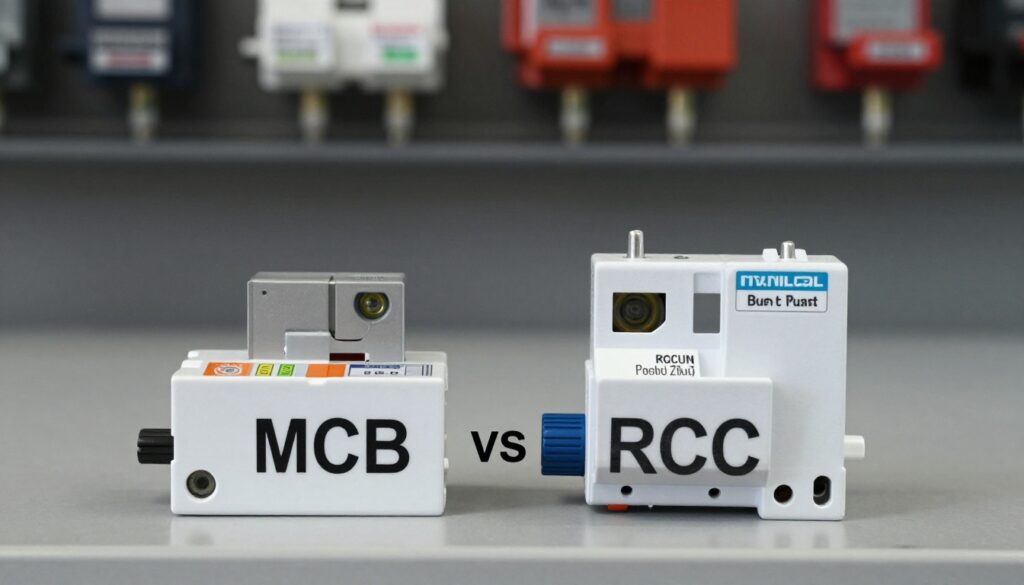
MCBs protect your equipment and the actual structure of your house. RCCBs are there to protect your life from dangerous electric shocks. You cannot use one of these to do the work of the other. Modern safety codes usually say you must have both of them installed.
| Feature | MCB | RCCB |
|---|---|---|
| Protection Type | Overcurrent & Short circuit | Earth leakage & Electrocution |
| Detection Method | Thermal + Magnetic | Current imbalance (differential) |
| Trip Threshold | 100-1000% of rated current | 30mA, 100mA, or 300mA leakage |
| Response Time | 0.01s (magnetic) to 60s (thermal) | 0.04s to 0.3s depending on current |
| Protects Against | Fire, equipment damage | Electric shock, electrocution |
| Can work alone? | Yes (but no shock protection) | No (needs MCB for overcurrent) |
The critical insight: An RCCB will NOT trip on overload or short circuit. If you connect too many appliances, drawing 40A through a 32A circuit, the RCCB does nothing—you need an MCB. Conversely, if someone touches a live wire and 50mA flows through their body to earth, an MCB sees this as insignificant current and won’t trip—you need an RCCB.
Cost Analysis and ROI Calculations
Basic MCBs are affordable, typically costing between ₹150 to ₹400 each depending on brand and rating. RCCBs cost more, usually ranging from ₹800 to ₹2,500 depending on current rating and poles. You can also buy an RCBO (combined MCB+RCCB) which combines both functions in one unit at ₹1,200-₹2,800 per device.
💰 Investment Comparison for Typical 3-Bedroom Home (Indian Market)
Option 1: MCB-Only System (Minimal Protection)
- 1× Main MCB (63A, DP): ₹450
- 6× Single-pole MCBs (6A-32A): ₹1,200
- 8-way distribution board: ₹1,800
- Installation labor + wiring: ₹3,500
- Total: ₹6,950
Option 2: MCB + RCCB System (Recommended)
- 1× Main MCB (63A, DP): ₹450
- 6× Single-pole MCBs: ₹1,200
- 2× RCCBs (30mA, 2-pole, 40A): ₹3,200
- 12-way distribution board: ₹2,500
- Installation labor + wiring: ₹4,500
- Total: ₹11,850
Option 3: RCBO System (Premium)
- 1× Main MCB (63A, DP): ₹450
- 6× RCBOs (various ratings): ₹10,800
- 12-way distribution board: ₹2,500
- Installation labor + wiring: ₹5,000
- Total: ₹18,750
ROI Analysis:
Additional investment for Option 2: ₹4,900
Potential savings from prevented accidents:
- Average electrical fire damage in India: ₹3,00,000-₹8,00,000
- Insurance deductible: ₹25,000-₹50,000
- Electrical appliance replacement: ₹50,000-₹2,00,000
- Medical costs from electrical shock: ₹1,00,000-₹5,00,000
- Potential loss of life: Priceless
Payback if prevents ONE incident: Immediate (60-160× ROI)
Note: Prices based on standard brands like Havells, Legrand, Schneider Electric, L&T available in Indian market as of 2025-26.
Smart Installation Strategy for Maximum Protection
One big RCCB for the whole house is a risky choice. A small leak in the garage could kill all your lights. Using separate units for different rooms makes your life much easier. This simple setup saves you money on expensive emergency repair calls.
🏠 Optimal Distribution Strategy:
- RCCB #1 (30mA): Kitchen, bathrooms, outdoor circuits (high-risk wet areas)
- RCCB #2 (30mA): Bedrooms, laundry, garage (moderate-risk areas)
- MCB-only: Lighting circuits, central HVAC (low shock risk, high nuisance trip risk)
Put your money where the water is for the best results. Use 30mA RCCBs in kitchens, bathrooms, and all your outdoor areas. These are the spots where shocks happen to people most often. Dry rooms can rely on simple MCBs for basic overload protection.
For critical circuits like security systems, fire alarms, and freezers, use MCB-only protection. These circuits must not trip due to minor leakage currents. A false RCCB trip at 3 AM that spoils ₹8,000-₹15,000 worth of frozen food teaches this lesson the expensive way.
Testing and Maintenance Schedule
Press the test button on your RCCB at least once every month. It should click off right away to show it still works. If it sticks, you need to buy a new unit right away. Get a pro to check your whole board every few years. This keeps everything sharp and ready for a potential fault.
🔧 RCCB Test Button Operation
The test button creates an artificial 30mA (or rated) leakage by connecting live to earth through a high-value resistor.
For 230V, 30mA RCCB:
Test resistor value = V ÷ I = 230V ÷ 0.03A = 7,667Ω (typically 7.5kΩ)
When you press the test button, exactly 30.67mA flows to earth, and the RCCB should trip within 300ms. If it doesn’t trip or takes >2 seconds, the internal mechanism is degraded—replace immediately.
Old fuse boxes should be changed to modern boards right away. In February 2026, many insurance companies require these safety upgrades. It lowers your risk and might even drop your monthly insurance premiums by 5-15%. Adding an RCCB is a smart move for any older home today.
Conclusion: Building a Safe Electrical System
Smart safety does not have to be an expensive project. Use MCBs for power surges and overload protection. Add RCCBs for personal safety in wet areas and high-risk circuits. Test them often and buy quality brands from reputable manufacturers like Havells, Legrand, Schneider Electric, L&T, or Siemens—these will last 15-20 years.
The mathematics is clear: a ₹4,900 investment in proper RCCB protection provides a potential 60-160× return if it prevents a single electrical fire or shock incident. For engineers and homeowners alike, this represents one of the highest ROI safety investments available.
Remember the key technical distinctions: MCBs protect property through overcurrent detection, while RCCBs protect people through leakage current detection. Both are essential, neither is optional in modern electrical installations. A little bit of planning, proper calculations, and strategic placement keeps your family safe, your property protected, and your electrical system running optimally for decades.
Take Action Today: Audit your current electrical panel. If you lack RCCB protection in wet areas, schedule an upgrade with a licensed electrician. Your family’s safety is worth the investment.
Very informative