RTD & Thermocouple: Simplex, Duplex & Head Mounted Transmitter — Everything You Need to Know
Chapter 1: The RTD — Precision’s Best Friend
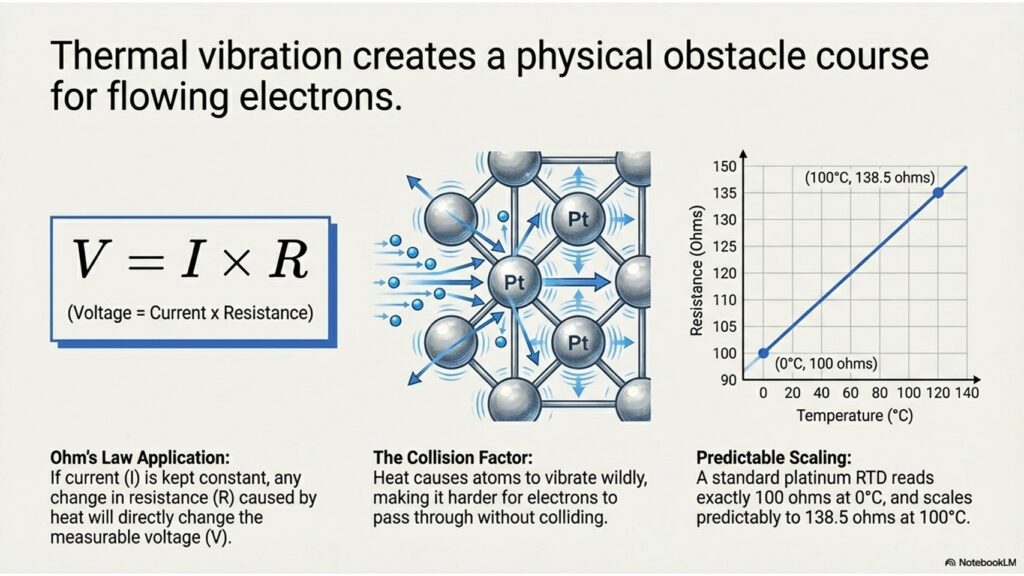
RTD stands for Resistance Temperature Detector. The idea is beautifully simple: when metal gets hot, its electrical resistance goes up in a very predictable way. By measuring that resistance, you know the exact temperature.
The most common type is PT100 — a platinum element with exactly 100 ohms resistance at 0°C. There is also PT1000 (1000 ohms at 0°C), which is more sensitive and better for low-current circuits. Platinum is chosen because it is stable, repeatable, and does not corrode easily.
Key Technical Characteristics of RTD
Chapter 2: The Thermocouple — Rugged and Wide-Range
A thermocouple works on the Seebeck Effect: when two different metals are joined at one end (the hot junction) and kept at a different temperature at the other end (the cold junction), a small voltage is generated. That voltage tells you the temperature.
Thermocouples can handle extreme heat — up to 1,700°C or even higher with special types — which makes them the go-to choice for furnaces, boilers, kilns, and engines. They are also self-powered (no excitation current needed) and extremely fast.
Common Thermocouple Types
| Type | Metals Used | Range (°C) | Best For |
|---|---|---|---|
| Type K | Chromel / Alumel | –200 to +1260 | General purpose, HVAC, ovens |
| Type J | Iron / Constantan | –40 to +750 | Plastics, older machinery |
| Type T | Copper / Constantan | –200 to +350 | Food, cryogenics, moisture areas |
| Type E | Chromel / Constantan | –40 to +900 | Highest sensitivity among base metals |
| Type N | Nicrosil / Nisil | –200 to +1300 | High temp, replaces Type K |
| Type R/S/B | Platinum-Rhodium | 0 to +1700 | Steel, glass, precious metal processes |
Chapter 3: Simplex vs Duplex — One Element or Two?
Here is where the story gets practical. Both RTDs and thermocouples come in two physical builds: Simplex and Duplex.
Simplex (Single Element)
A simplex sensor has one sensing element inside the protection tube. It is the standard choice for most applications — cost-effective, compact, and easy to install. One element means one measurement signal going to your control system.
Duplex (Dual Element)
A duplex sensor puts two independent sensing elements inside the same protection tube (sheath). Both elements measure the same process point but send separate signals. This gives you major advantages in critical processes.
Chapter 4: How They Are Built — Inside the Probe
Both RTDs and thermocouples share a common physical construction. The sensing element sits inside a mineral insulated (MI) cable — compacted magnesium oxide (MgO) powder fills the space between the element wires and the outer metal sheath. This MgO insulation is electrically isolating but thermally conducting, making the probe fast-responding and vibration-resistant.
The outer sheath is typically 316L stainless steel for general use, Inconel 600 for high-temperature or corrosive environments, or Hastelloy for aggressive chemical service. Sheath diameters range from 1.5 mm to 12 mm — smaller diameters respond faster.
Chapter 5: The Head Mounted Transmitter — Smart Signal, Long Distance
A raw RTD sends a resistance signal; a thermocouple sends millivolts. Over long cable runs (sometimes hundreds of meters in a plant), these weak signals pick up electrical noise and suffer from lead resistance errors. The solution is a Head Mounted Transmitter (HMT).
The transmitter sits directly inside the connection head — the small housing at the top of the sensor probe. It converts the raw sensor signal into a robust 4–20 mA current loop, which is immune to cable resistance and noise. Many modern transmitters also support HART protocol, allowing two-way digital communication on the same two wires — you can read sensor diagnostics, change range, or check for drift without opening the panel.
Key Features of Head Mounted Transmitters
Because the transmitter is loop-powered, it draws its operating power directly from the 4–20 mA signal loop — no separate power cable is needed. This simplifies wiring dramatically and reduces installation cost.
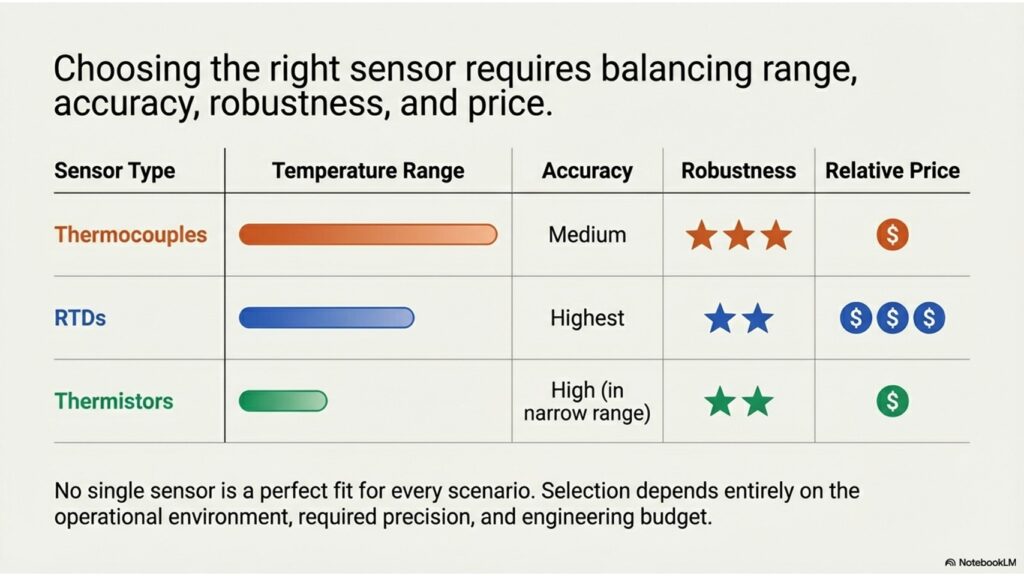
Chapter 6: RTD vs Thermocouple — Which One to Choose?
| Feature | RTD (PT100) | Thermocouple |
|---|---|---|
| Temperature Range | –200 to +850°C | –200 to +1700°C |
| Accuracy | Very High (±0.1°C) | Moderate (±1–2°C typical) |
| Stability / Drift | Excellent, low drift | Higher drift at elevated temps |
| Response Time | Slower (2–10 sec) | Faster (<1 sec) |
| Self-Powered | No (needs excitation) | Yes (Seebeck voltage) |
| Cost | Higher | Lower |
| Vibration Resistance | Good (MI type) | Excellent |
| Best Application | Precision process control | High-temp, furnaces, engines |
Chapter 7: Where Are They Used?
RTDs are the preferred choice in oil & gas pipelines, pharmaceutical manufacturing, food processing, and chemical reactors — anywhere precise, stable temperature measurement is critical for quality or safety. Their high accuracy makes them ideal for custody transfer metering and environmental monitoring.
Thermocouples dominate steel mills, glass furnaces, power plant boilers, automotive exhaust systems, and heat treatment ovens — processes that run too hot for RTDs or where fast response matters more than ultra-precision.
Duplex configurations are standard in SIL 2/3 safety loops, nuclear facilities, turbine monitoring, and critical reactor vessels. Head mounted transmitters are now the preferred signal conditioning method across almost all modern DCS and SCADA installations.
📥 Download This Article as PDF
Save the complete RTD & Thermocouple guide — including all spec tables and comparison charts — as a PDF for offline reference or team training.
Download PDF Guide