
Control-valve-flow-characteristics
Reading Time: 6 minutes | Level: Intermediate
Why This Matters (And Why You’re Probably Getting It Wrong)
Picture this: You’re troubleshooting a temperature control loop. The PID is tuned. The sensor is calibrated. But the valve oscillates like crazy.
The problem? Wrong flow characteristic.
I’ve seen this cost plants crores in lost production, damage equipment, and drive operators insane. Yet most engineers barely think about it during the design process.
Let me fix that in the next 6 minutes.
🧩 Quick Test: Do You Know Your Stuff?
You’re controlling temperature in a heat exchanger with long piping runs and multiple fittings. Which valve characteristic do you choose?
A) Linear
B) Equal Percentage
C) Quick Opening
(Answer at the end—keep reading!)
What Are Flow Characteristics Anyway?
Flow characteristic = How flow changes when you move the valve stem.
Simple as that.
But here’s the kicker: Choose wrong, and no amount of PID tuning will save you.
There are three types you need to know:
1. Linear: The “Honest” Valve
The Simple Explanation
Human Example: Turn a garden hose tap 50% open → get 50% flow. Turn it 75% open → get 75% flow. Completely predictable.
The Graph

Key Point: Equal steps in valve opening = equal steps in flow rate.
Where to Use It
- Liquid level control (water tanks, surge drums)
- Flow control with constant pressure
- Systems where valve ΔP > 70% of total ΔP
Real Example
Cooling water system: Constant pump pressure, short piping. A linear valve works perfectly because system pressure drop doesn’t change.
The Catch
Works great when system resistance is constant. But if pressure varies (long piping, changing loads)? You’ll get unstable control at low flows and sluggish response at high flows.
Common Mistake: “Linear is simpler, so I’ll use it everywhere.”
Reality: Linear is simpler to understand, not simpler to control in real systems.
2. Equal Percentage: The Industry Workhorse
The Simple Explanation
Human Example: Pushing a stuck car. First 25% of effort moves it 5%. Next 25% gets you 15%. Next 25% gives 40%. Final 25% rockets to 100%.
Small changes at low flow, massive changes at high flow.
The Graph
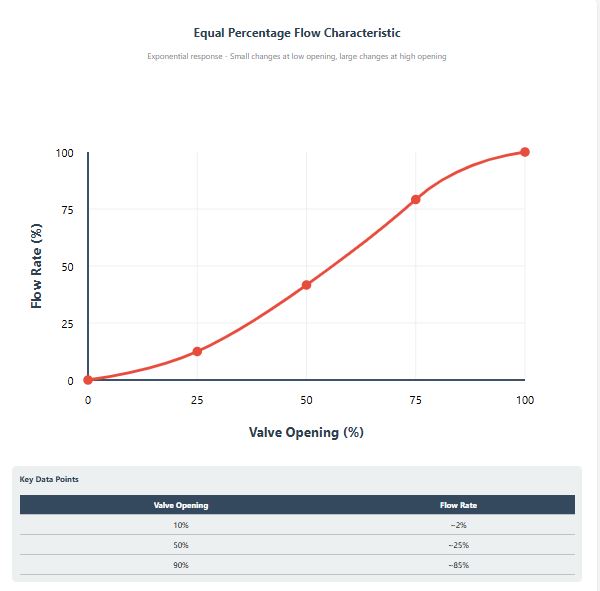
Key Numbers:
- 10% open → ~2% flow
- 50% open → ~25% flow
- 90% open → ~85% flow
Why It’s Called “Equal Percentage”
Each equal step in valve travel changes flow by the same percentage of the previous flow.
At 20% open: 10% increase in travel → 50% increase in flow (from 4% to 6%)
At 80% open: 10% increase in travel → 50% increase in flow (from 60% to 90%)
Where to Use It (This Is Important!)
- Temperature control (heat exchangers, reactors)
- Pressure control (steam, gas systems)
- ANY system with variable pressure drop
- Long piping with high resistance
- Basically 70% of all control applications
Real Example
Steam heat exchanger: At low load, you need fine control—small steam changes make big temperature swings. At high load, you need the valve wide open. Equal percentage gives you precision at low flows and capacity at high flows.
Why Engineers Love It
It maintains constant loop gain across the operating range.
This is HUGE. Your PID tuning stays consistent whether you’re at 10% or 90% capacity.
The Horror Story
A batch reactor used a linear valve for cooling control. During the exothermic reaction (low cooling demand), tiny controller movements caused massive temperature swings. During dilution (high cooling demand), the valve barely responded. Yield dropped from 94% to 82%—costing $200K annually. After switching to equal percentage? Stable control, yield back to 93%.
3. Quick Opening: The Emergency Valve
The Simple Explanation
Human Example: Opening a door. The first 20% of movement lets in 60% of the light. Halfway open doesn’t add much more. Fully open only adds that last bit.
The Graph
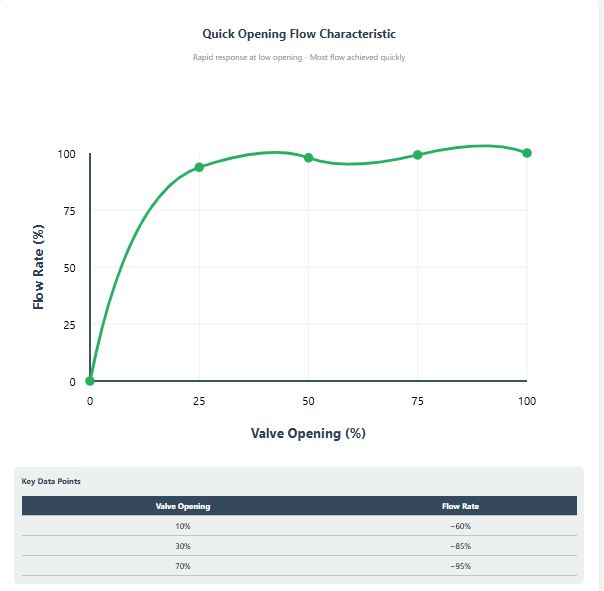
Key Numbers:
- 10% open → ~60% flow (!!)
- 30% open → ~85% flow
- 70% open → ~95% flow
Where to Use It
- Emergency systems (reactor quench, safety showers)
- On/off service
- Relief systems
- Nowhere else!
Why You Should Almost Never Use This
It’s TERRIBLE for modulating control. Imagine trying to drive a car where touching the gas pedal gives you 60% throttle. Impossible to control smoothly.
The Disaster Story
Someone installed quick-opening valves on steam pressure control (they got a deal on surplus valves). The pressure oscillated ±2 bar continuously. Controller output swung 0-100% every 20 seconds. Three heat exchangers developed leaks from thermal shock within six months. Repair cost: $85K. Proper equal percentage valve cost: $3,500.
Never use quick-opening for modulating control. Ever.
Side-by-Side Comparison
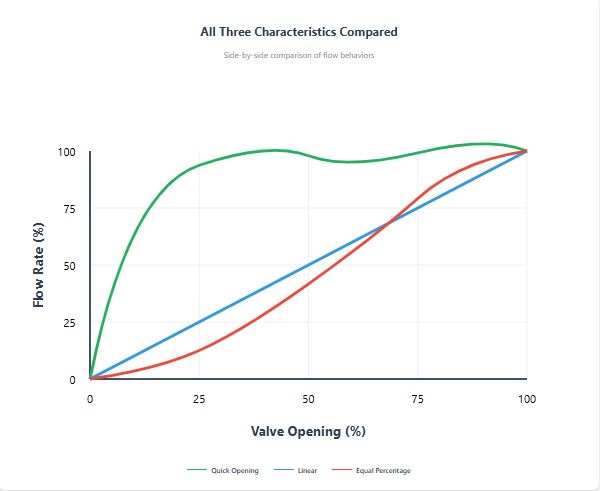
Notice how equal percentage gives you the smoothest, most controllable curve for typical applications.
The Selection Guide: Your Cheat Sheet
STEP 1: Calculate Valve ΔP Ratio
Valve ΔP ÷ Total System ΔP = ?
- >70% → Linear works
- 30-70% → Equal percentage recommended
- <30% → Equal percentage REQUIRED
STEP 2: What Are You Controlling?
| Control Variable | Best Choice |
|---|---|
| Temperature | Equal Percentage (99% of time) |
| Pressure | Equal Percentage |
| Flow (constant ΔP) | Linear |
| Level | Linear |
| Emergency/On-Off | Quick Opening |
STEP 3: Does System Resistance Change?
- Yes (long piping, varying loads) → Equal percentage
- No (short piping, constant pump) → Linear can work
When In Doubt?
Choose equal percentage. It’s the safe bet for 70% of applications.
🎯 Challenge: Can You Solve This?
You’re designing chemical dosing control. The dosing pump runs at variable speed (20-100%). The valve is 150 meters from the pump with six 90° elbows. Which characteristic?
Think about:
- Pump pressure changes with speed (a lot!)
- Long piping = high process resistance
- Need consistent control across the dosing range
Answer: Equal percentage. The pump pressure varies dramatically, creating variable system ΔP. Long piping means low valve ΔP ratio. Equal percentage maintains consistent loop gain as conditions change.
What Happens When You Get It Wrong?
Real Consequences I’ve Witnessed:
Production Loss: A refinery ran at 85% capacity for two years because reformer temperature control was unstable. Root cause? Linear valves where equal percentage was needed. Annual loss: $2.1M.
Equipment Damage: Feedwater control with quick-opening valves caused constant pressure oscillations. Three pumps cavitated and failed in 18 months.
Safety Incident: Wrong flow characteristic on reactor cooling nearly caused a thermal runaway. The valve couldn’t maintain temperature during an upset.
Maintenance Nightmare: 23 valves with wrong characteristics caused constant loop hunting. After retrofit: maintenance calls dropped 70%.
The Hidden Truth: Installed vs. Inherent
Here’s something that trips up even experienced engineers:
Inherent Characteristic = What the valve does on a test bench
Installed Characteristic = What it actually does in YOUR system
The problem:
- A linear valve in high-resistance systems behaves like quick-opening
- An equal percentage valve in low-resistance systems behaves like linear
The fix:
Choose the inherent characteristic that gives you a LINEAR installed characteristic. For most systems with variable resistance, that means equal percentage.
Your Action Plan
For New Designs:
- Calculate valve ΔP ratio (target >30%)
- Default to equal percentage unless you have a specific reason for linear
- Never use quick opening for modulating control
- Document your selection rationale
For Existing Problems:
- If loops are hunting, check flow characteristic FIRST
- Look for valves stuck at extremes (0-10% or 90-100%)
- Question any linear valves on temperature or pressure control
- Calculate ROI for retrofits—it’s usually excellent
Common Mistakes to Avoid
❌ “Linear is simpler, I’ll use that”
✓ Equal percentage is simpler to CONTROL in real systems
❌ “I’ll just tune the controller better”
✓ No amount of PID tuning fixes wrong flow characteristic
❌ “Quick opening sounds fast, perfect for my process”
✓ Quick opening = emergency flow, not fast control
❌ “I’ll copy what worked on the last project”
✓ Different systems need different characteristics
The Bottom Line
You can have the best PID algorithm, most accurate sensor, and fastest controller. But if your valve has the wrong flow characteristic, you’re racing with bicycle tires.
When in doubt: Choose equal percentage.
It’s the industry standard because it works in the widest range of applications and compensates for real-world variations.
And please, never use quick opening for modulating control.
🎯 Remember the Opening Quiz?
Heat exchanger with long piping and multiple fittings—which characteristic?
Answer: B) Equal Percentage
Why?
- Long piping = high process resistance = low valve ΔP ratio
- Temperature control needs stable gain
- Variable loads change system resistance
- Equal percentage maintains constant loop gain
- Linear would be too sensitive at low loads, sluggish at high loads
Got it wrong? That’s okay—now you know why it matters.
Want More?
Questions? Drop them in the comments below.
Struggling with an unstable loop? Share your symptoms—let’s troubleshoot together.
Have a flow characteristic horror story? I want to hear it!
Lovely stuff engineer
Thanks for reply.
Looking forward for regular visit & suggestions.